
- Gold/Au $6888.54
- Silver/Ag $108.22
- Platinum/Pt $2982.28
- Palladium/Pd $2276.88
- Last Update: 7th Oct 2025 @ 15:56pm


Physical vs. Digital Gold in 2026: Why Brisbane Investors Prefer Tangible Wealth

The 2026 Gold Landscape in Australia
As we move deeper into 2026, global gold markets remain firmly in a long-term bull cycle. Major financial institutions, including Goldman Sachs, HSBC, and Société Générale, project gold could approach the $4,800–$5,000 USD range by the end of 2026, supported by persistent inflation, geopolitical tension, and strong central-bank demand. This outlook continues to reinforce gold’s role as a core wealth-preservation asset for Australian investors. The rise of fintech has introduced a modern dilemma: should you buy “Digital Gold” through a sleek smartphone app, or stick to the traditional “Physical Gold” held in a secure safe or private vault? While the digital promise of “gold at a tap” is tempting, 2026 has exposed the fragile nature of digital claims.
From platform outages to the lack of direct ownership, many investors are rediscovering why “if you can’t hold it, you don’t own it” remains the golden rule of wealth preservation. In this comprehensive guide, we examine why Brisbane families and professional investors are increasingly shifting their capital from digital certificates to tangible bullion. We will explore the hidden risks of 2026’s digital platforms and why the physical market in Queensland offers a level of security and liquidity that no app can replicate.
Defining the Contenders: Physical vs. Digital Gold
Before diving into the strategic advantages, it is essential to understand the two very different ways you can gain exposure to gold in the current market.
What is Physical Gold?
Physical gold refers to tangible assets that have intrinsic value. This includes bullion bars, investment-grade coins (like the Australian Kangaroo or Sovereign), and even high-carat jewellery. When you buy physical gold from a reputable Brisbane dealer, the metal is yours. It exists in the physical world, requires no electricity to verify, and can be transported, gifted, or liquidated privately.
What is Digital Gold?
Digital gold is an electronic representation of the metal. Often sold through fintech apps or as “tokenised assets” on a blockchain, it allows you to buy fractional amounts—sometimes as little as $10 AUD worth. The provider typically claims to store the equivalent physical metal in a central vault on your behalf. While it is easy to trade, you are essentially holding a digital receipt rather than the gold itself.
Is Physical Gold Better than Digital Gold in 2026?
Yes. While digital gold offers convenience for small-scale speculation, physical gold remains the only asset with zero counterparty risk and instant local liquidity. In 2026, gold prices in Australia have climbed to multi-year highs, driven by strong global demand, central-bank accumulation, and ongoing economic uncertainty, prompting Brisbane investors to increasingly prioritize tangible wealth.
The Brisbane Difference: Why Possession is Key
For Brisbane investors, the choice between these two often comes down to the concept of direct ownership. In a year marked by global cybersecurity concerns and fluctuating bank stability, having a portion of your wealth completely outside the banking system is a strategic necessity. Physical gold provides that “off-grid” security, whereas digital gold remains tethered to the very systems many investors are trying to hedge against.
The “Counterparty Risk” Trap of 2026
One of the most significant, yet often ignored, dangers of the 2026 investment market is counterparty risk. In financial terms, this is the risk that the other party in your contract—in this case, the digital gold platform—will fail to deliver on their promise.
The Illusion of Ownership
When you “buy” gold on an app, you are entering into a contract with a company. You are trusting their servers to stay online, their auditors to be honest, and their insurance to be sufficient. If the platform faces a hack, a technical “glitch,” or insolvency, your digital gold could become a frozen entry on a screen.
Regulatory oversight of digital gold products varies by jurisdiction. In Australia, investors should carefully assess whether a platform offers fully allocated gold, how custody is structured, and what protections apply if a provider fails. Unlike physical bullion held directly by the owner, digital gold always involves reliance on third-party systems and contractual arrangements.
Physical Gold: The Asset with No “Switch”
In contrast, physical gold has zero counterparty risk. It does not rely on an internet connection, a company’s balance sheet, or a CEO’s integrity. If you have a 1oz gold bar in your hand, its value is recognised globally, from Brisbane to Berlin. There is no “off-switch” for physical wealth. For those looking to protect their family’s future in an increasingly volatile 2026, the peace of mind that comes with physical possession is an advantage that digital gold cannot match.
Why Tangibility Matters for Brisbane Families
While spreadsheets and stock charts dominate financial news, for most Brisbane families, wealth is about stability and a sense of peace of mind. In 2026, the psychological and practical benefits of physical gold have led to a significant shift in local investment habits.
The “Safe Haven” Effect in Local Households
History has repeatedly shown that gold behaves differently during periods of systemic panic. In 2026, with global debt levels reaching a record $340 trillion and persistent inflation eating into the purchasing power of the Australian Dollar, physical gold acts as a “Golden Shield” for local savings. Unlike a digital entry, a physical gold bar is a non-yielding asset that does not rely on a company’s quarterly earnings or a government’s fiscal policy. It provides a tactile sense of security—knowing that a portion of your wealth is real, unencumbered, and within arm’s reach.
Generational Wealth and Legacy
For many Queenslanders, gold is more than just a ticker symbol; it is an intergenerational asset. Digital gold is often tied to individual accounts, passwords, and platform-specific inheritance rules that can be complex to navigate. Physical bullion, however, is easily passed down to children or grandchildren without the need for digital access or platform permissions. Whether it’s a collection of Gold Kangaroo coins or heirloom jewellery, physical gold is a timeless store of value that has crossed centuries of wars and currency resets.
Privacy and Total Control
In an era where every digital transaction is tracked and centralised, physical gold offers a rare level of financial privacy. Storing gold privately or in an independent local vault allows you to maintain control over your assets without constant bank involvement. For Brisbane investors who value independence, the ability to hold an asset that is completely outside the digital financial system is one of the most compelling reasons to choose tangible metal over digital certificates in 2026.
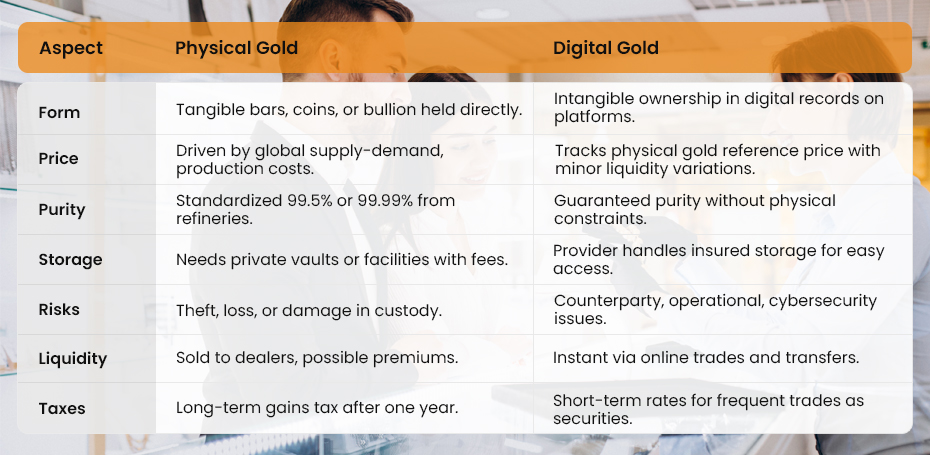
Liquidity Realities—Digital Clicks vs. Brisbane Cash
Liquidity—the ease with which you can turn an asset into cash—is often cited as the main advantage of digital gold. However, the 2026 market has revealed that “digital liquidity” is not always as simple as it looks on a smartphone screen.
The Digital “Friction” Problem
While selling digital gold on an app takes just a few clicks, getting that money into your bank account can involve significant delays. Platforms often have 24-48 hour settlement periods, and many impose “redemption fees” or “spreads” (the difference between buying and selling prices) that can reach 3% to 5%. Furthermore, many digital platforms have a “minimum weight” requirement if you ever want to convert your digital balance into actual physical metal, often requiring you to hold 10 grams or more before you can request delivery.
The Brisbane Cash Advantage
In contrast, physical gold offers immediate, local liquidity. If you are holding physical bullion or jewellery in Brisbane, you don’t have to wait for a digital settlement or worry about a platform’s server status. At Gold Buyers QLD, we provide instant AUD payouts. You simply walk in with your gold and walk out with cash or a direct bank transfer on the same day.
In a crisis—such as a cyber-event or a banking holiday—digital gold could be frozen and inaccessible. Physical gold remains “spendable” and universally recognised. For a Brisbane resident, the ability to walk into a local shop and liquidate an asset in 15 minutes provides a level of true liquidity that far surpasses the theoretical speed of an app.
2026 Market Analysis & Statistics
The growing preference for physical gold in 2026 reflects broader shifts in global investment behaviour. Across both institutional and private markets, demand for hard assets has strengthened as investors seek protection from inflation, currency volatility, and geopolitical uncertainty. Gold continues to serve as a cornerstone of portfolio stability during periods of financial stress.
Institutional Support and Market Outlook
Major financial institutions consistently describe gold as being in a long-term structural uptrend. While precise price targets vary between analysts, the overall outlook remains strongly positive, supported by sustained central-bank accumulation, ongoing inflation pressures, and heightened global risk exposure. This institutional confidence reinforces gold’s role as a strategic reserve asset rather than a short-term trade.
The Rise of Private Bullion Demand
Private investors have mirrored this institutional shift. Recent industry research indicates that both central banks and private investors continue to accumulate gold at elevated levels, reflecting strong long-term confidence in tangible assets. High-net-worth individuals in particular have expanded their exposure to physical bullion as a hedge against market instability and currency depreciation.
Gold Investment Landscape (2026)
| Investment Type | Market Preference | Primary Risk |
|---|---|---|
| Physical Bullion (Bars & Coins) | Strong | Theft (if not stored securely) |
| Gold ETFs (Paper Gold) | Moderate | Indirect ownership / Custodian risk |
| Digital Gold Platforms | Growing | Platform risk / Cybersecurity |
The Cost of Convenience—Fees You Didn’t See Coming
Digital gold is often marketed as a low-cost alternative to physical bullion, but the 2026 market has exposed a complex web of recurring fees that can quietly erode your long-term returns. While physical gold has a higher upfront cost, its “carry cost” over time is often significantly lower.
The Digital “Spread” and Platform Fees
When you buy gold through an app, you do not pay only the spot price. Most digital platforms in Australia charge a transaction fee, typically between 0.5% and 2%, on both the buy and sell gold transactions. Furthermore, the “spread”—the difference between the price at which you buy and the price at which the platform buys it back—can be wider than in the physical market, often hidden within the app’s quoted rates.
Recurring Storage and Vaulting Costs
Unlike physical gold stored at home, digital gold lives in a commercial vault. While many apps offer “free storage” for an initial period, they often pivot to a recurring fee model after a certain threshold. In 2026, many Australian digital providers charge between 0.4% and 1% per annum for allocated storage. Over a 10-year investment horizon, these small percentages compound, potentially costing you thousands in “holding fees” that a physical bar in your safe would never incur.
How to Transition from Digital to Physical
If you currently hold digital gold and are concerned about platform risk or the rising cost of fees, 2026 is an ideal year to “materialise” your wealth. Converting digital certificates into physical bullion is a straightforward process that secures your gains into a tangible asset.
The “Accumulate and Redeem” Strategy
Many Brisbane investors use digital gold as a “savings funnel”—buying small fractional amounts every payday. Once they reach a significant weight (such as 1 ounce or 50 grams), they liquidate their digital position and visit a local dealer like Gold Buyers QLD to purchase physical bars. This gives you the convenience of digital accumulation with the ultimate security of physical possession.
Protecting Your Gains in a Volatile Market
With gold prices reaching record highs this year, “locking in” your digital profits by converting them into physical bullion ensures that your wealth is no longer dependent on an app’s solvency. In the event of a 2026 technical outage or regulatory shift, your physical gold remains yours, regardless of what happens to the digital platform’s infrastructure.
Conclusion: The Golden Shield of 2026
As we have seen, the choice between digital and physical gold isn’t just about technology—it’s about control. While digital gold offers a gateway for beginners, it carries inherent “counterparty risks” and recurring fees that can compromise your financial independence. In a world of digital uncertainty, physical gold remains the ultimate “Golden Shield,” providing a tangible, private, and highly liquid asset that you can hold in your own hands.
Whether you are looking to diversify your portfolio or convert your digital gains into lasting wealth, 2026 is the year to prioritise the security of the physical market.
Turn Your Physical Gold Into Instant Cash Today
Visit our secure store today.
About the Author
Raj, Specialist at Gold Buyers Brisbane
With deep expertise in the gold buying industry, Raj leads Gold Buyers Brisbane’s mission to provide fair and transparent cash offers for gold. Committed to customer satisfaction, Raj ensures clients receive trusted valuations and seamless transactions, leveraging extensive knowledge of the local market and current gold trends.
About the Company
Gold Buyers Brisbane is a premier gold buying service based in Brisbane, dedicated to offering the highest cash payouts for gold. With a focus on trust, transparency, and expert evaluations, Gold Buyers Brisbane helps customers get the best value for their gold items quickly and securely. Serving the Brisbane community, the company blends industry expertise with customer-centric service to make gold selling a confident and rewarding experience.
Frequently Asked Questions
-
Is digital gold safe in Australia?
Digital gold is generally safe if held through reputable, audited institutions. However, many newer fintech apps operate with limited regulatory oversight. Always check if your provider offers "allocated" gold (where you own specific bars) rather than "unallocated" (where you are just a general creditor). -
Can I trade digital gold for physical bars in Brisbane?
Most apps do not offer direct "swaps." Usually, you must sell your digital position for AUD and then use those funds to purchase physical bullion from a local dealer. Visiting a physical store allows you to make this transition in a single day. -
Does physical gold have higher taxes?
In Australia, physical gold is subject to Capital Gains Tax (CGT) just like digital gold. However, personal use assets (like most jewelry) are often exempt if they cost less than $10,000 to acquire. For investment bullion held for over 12 months, you may be eligible for a 50% CGT discount. -
How do I store physical gold safely?
Options range from high-quality home safes to private vaulting facilities in Brisbane. Many investors prefer a "hybrid" approach: keeping a small amount at home for emergency access and the bulk in a professional, insured vault. -
Why is the Brisbane gold price different from the global spot price?
The global spot price is quoted in USD per ounce. The price you see in Brisbane includes the USD/AUD exchange rate, local transport, insurance, and the dealer's small premium. In 2026, the weakening AUD has actually made local gold prices much higher than the global average.
 Previous